

Ask anyone who has spent three days in Siem Reap what they remember and you will hear the same three words: Angkor Wat, sunrise, heat. Ask someone who stayed six days and the answers get stranger and better. A pink sandstone temple carved so finely it looks like wood. A jungle ruin you climb through rather than walk around. A pyramid standing alone in the forest two hours from the nearest cappuccino. A village on stilts that towers eight or ten metres above the ground in April and sits at water level in October.
That is the real case for day trips from Siem Reap. The main Angkor park is extraordinary, but it is only the centre of a much bigger world the Khmer kings built across north-west Cambodia. Past the famous circuits there are temples that still feel half-discovered, a sacred mountain Cambodians treat as the birthplace of their kingdom, and a great lake that fed the whole civilisation.
I have written this the way I would brief a friend flying in from Singapore for a long weekend. Which trips are worth the drive, how long they honestly take, what the Angkor pass does and does not cover, which trips pair well, and where people waste a day. Prices quoted are HolidaySG "from" prices at the time of writing (October 2026). Ticket rules, entry fees and opening hours in Cambodia change, so treat anything about passes and fees as a starting point and confirm before you go.
The short answer: which trip suits you?
Distances are approximate road journeys from central Siem Reap. Roads improve every year, but traffic, rain and the odd water buffalo all add minutes, so pad your plan.
| Day trip | What it is | Drive each way | Angkor pass | Best for |
|---|---|---|---|---|
| Banteay Srei and Kbal Spean | A tiny, exquisitely carved pink temple, then a riverbed of carved lingas | 45 min to 1 hr | Generally covered | Art lovers; almost everyone |
| Beng Mealea | A vast, mostly unrestored temple swallowed by jungle | About 1.5 hrs | Separate ticket | Adventurous travellers, photographers |
| Koh Ker | A short-lived capital with a seven-tiered pyramid | 2 to 2.5 hrs | Separate ticket | History buffs, people who want quiet |
| Phnom Kulen | A sacred mountain with waterfalls and a reclining Buddha | About 1.5 hrs | Separate ticket | Nature lovers, hot-season relief |
| Tonle Sap villages | Stilt and floating communities on the great lake | 30 to 60 min, then a boat | Not covered, boat fee | Curious travellers, sunset fans |
| Countryside and cooking | Villages, rice fields, bikes and a market-to-table class | Minutes away | Not needed | Rest days, food lovers, families |
If you only have one extra day beyond the main temples, make it a Banteay Srei and Kbal Spean morning. If you have two, add Beng Mealea and Koh Ker together, a pairing travellers tend to talk about for years afterwards. If you have three, bring in Phnom Kulen and give the lake an afternoon.
First, a word about the Angkor pass
Nearly every conversation about Siem Reap day trips starts with the pass, so let us settle it. The Angkor Archaeological Park ticket is sold as a one-day, three-day or seven-day pass, and the multi-day versions are valid across a longer window so you do not have to use the days back to back. Prices are published in US dollars and have been revised before. Our own temple-tour listings quote around US$37 for a one-day pass at the time of writing, but check the current schedule when you book.
What matters for day trips is coverage. Broadly speaking, the pass covers the main park temples (Angkor Wat, Angkor Thom with the Bayon, Ta Prohm and the rest of the Small and Grand Circuits) and a handful of outlying sites such as Banteay Srei, Banteay Samre and the Roluos group. It does not cover Beng Mealea, Koh Ker or Phnom Kulen, which sell their own tickets at the gate. Rules like this shift, so ask your driver or your tour operator on the day.
| Place | Usually on the Angkor pass? | Where you pay | Planning note |
|---|---|---|---|
| Angkor Wat, Bayon, Ta Prohm | Yes | Angkor ticket office | Pass checked at each gate |
| Banteay Srei, Banteay Samre | Generally yes | Angkor ticket office | Carry the pass, it has your photo |
| Beng Mealea | No | At the site | Small separate fee, cash is simplest |
| Koh Ker | No | At the site | Longer drive, so start early |
| Phnom Kulen | No | At the mountain gate | Fee covers the park and the waterfall area |
Two practical tips. Your pass carries your photo and is checked at many temples, so keep it on you all day, not in the hotel safe. And if you would rather skip the ticket-office queue, HolidaySG lists an express service for the Angkor Temple Pass from around S$57.15. Outside the sunrise rush the ticket queue is often manageable, so choose based on your schedule, not fear. See the express pass service.
Banteay Srei and Kbal Spean: the finest carving in Cambodia
Banteay Srei is small, and that is the first surprise. After the scale of Angkor Wat you walk in and find a temple you could circle in a few minutes. Then you look closely.
Built in the tenth century from a warm pinkish sandstone, it carries some of the most intricate carving in the Khmer world. Pediments tell scenes from the Hindu epics. Doorways are framed by delicate female figures whose jewellery and hairstyles are rendered in startling detail. The name is usually translated as "citadel of women" or "citadel of beauty", and one popular theory is that carving this fine must have been the work of women. Nobody really knows, which is part of the charm.
How to see it well
Go early or late. Low sun makes the pink stone glow, and the big tour groups usually arrive mid-morning. Look up, look close, and bring a guide if you can, because this is a temple of stories rather than views. You cannot enter the inner sanctuary; you walk a roped path around it. That is fine, since most of the best carving is visible from outside.
Add Kbal Spean
About half an hour further north, Kbal Spean is a riverbed in the Kulen foothills carved with hundreds of lingas, symbols of Shiva, and images of gods that the water runs across. Reaching it means a walk uphill through forest, often 40 minutes to an hour each way depending on your pace, on a path with roots and rocks. The carvings are clearest in the dry season when the water is low. In the late wet season you hear the river more than you see the carvings, but the forest walk is lovely either way.
On the way back many drivers stop at Banteay Samre, a well-restored temple with an Angkor Wat flavour and far fewer visitors. Some also stop at the landmine museum near the road, which tells a sobering and important story about Cambodia's recent past and is worth the half hour.
How to do it
A private car or tuk-tuk is easiest. A tuk-tuk is slower and more fun; a car is cooler and better if you plan to chain several sites. HolidaySG's Small Circle or Big Circle car charter with sunset viewing is from around S$26.26 and is a good way to cover the main park before you venture further. See the Small and Big Circle charter.
Beng Mealea: the temple the jungle kept
If Ta Prohm is the temple most people picture when they think of trees swallowing ruins, Beng Mealea is what Ta Prohm might have looked like before anyone tidied up. It dates from around the Angkor Wat era, it is enormous, and it is largely unrestored: collapsed galleries, heaps of carved blocks, roots as thick as a thigh, and moss on everything.
Visiting feels like exploration. Raised wooden walkways carry you over the worst of the rubble, and in places you duck under fallen lintels and step through doorways into dark corridors that smell of damp stone. It is not for anyone unsteady on their feet, and it can be slippery after rain, but for many travellers it is the most memorable temple of the whole trip.
Practical notes
- Separate ticket. Beng Mealea sits outside the Angkor pass. The fee is modest and paid at the site.
- Timing. It is around an hour and a half by road. Leave early and you arrive before the tour groups, with soft light through the trees.
- Footwear. Closed shoes with grip. Flip-flops and wet moss do not mix.
- Local guides. Someone at the entrance may offer to lead you through the less obvious routes. Agree the scope and fee clearly first, and put safety ahead of the perfect photo.
Koh Ker: a lost capital and its pyramid
For a short time in the tenth century the Khmer capital moved away from Angkor to Koh Ker. The king who moved it built on a grand scale, and the result is a remote, forested site with dozens of temples. The most famous is Prasat Thom, usually called the pyramid: seven stepped tiers rising out of the trees. Photos look almost Mesoamerican, and it is one of the most striking silhouettes in Cambodia.
Koh Ker is quiet. Even with better roads it sees a fraction of Angkor's visitors, and much of the site feels like your private discovery. It has also been recognised as a UNESCO World Heritage site in its own right.
Practical notes
- Separate ticket. Koh Ker has its own entry fee and is not covered by the Angkor pass.
- Distance. Expect two to two and a half hours each way, which is why most people pair it with Beng Mealea on the road out or back.
- Climbing. Visitors have been allowed on the pyramid in the past, and access rules can change for safety and conservation reasons. Ask on arrival and follow the signs.
- Supplies. Facilities are basic. Carry water, snacks and cash.
Beng Mealea and Koh Ker together
The classic combination is one very full day: leave around 6:30 am, reach Koh Ker by mid-morning, eat a simple lunch, drive back via Beng Mealea in the afternoon, and return after dark or close to it. It is a lot of hours in a vehicle, around five hours of driving, so a comfortable private car matters more than saving a few dollars. HolidaySG lists a private car charter covering both from S$126.81. See the Koh Ker and Beng Mealea charter.
| Time | Stop | What happens |
|---|---|---|
| 6:30 am | Leave Siem Reap | Coffee and a snack in the car |
| 9:00 am | Koh Ker | Prasat Thom, a few outlying prasats, plenty of silence |
| 12:30 pm | Lunch | Simple local food near the site or on the road |
| 2:30 pm | Beng Mealea | Walkways, fallen galleries, jungle light |
| 5:00 pm | Drive back | Arrive in Siem Reap around early evening |
If that sounds too much, split it: Beng Mealea on its own is a comfortable half day with a long lunch, while Koh Ker deserves a full day if you want time to walk its outlying temples.
Phnom Kulen: the sacred mountain
Phnom Kulen is the one trip where you actually leave the flat plain. A forested sandstone plateau about an hour and a half from town, it is the place where, according to tradition, the Khmer king declared the empire in the early ninth century. For Cambodians it remains a pilgrimage site, so on weekends and holidays you will share it with families on picnics rather than just tourists.
What to see
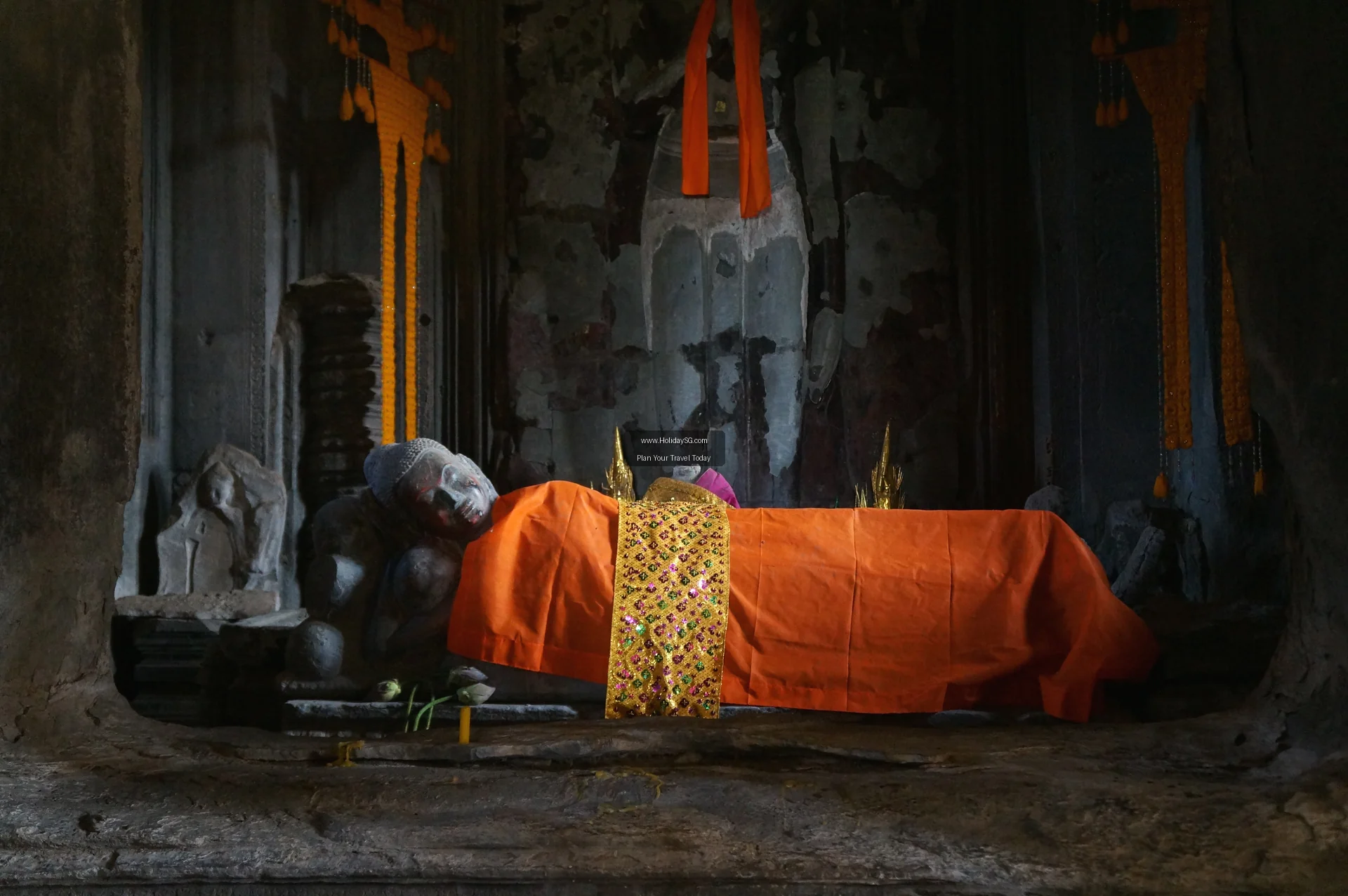
- The reclining Buddha. A large figure carved into a boulder near the top of the road, still an active place of worship.
- Waterfalls and pools. The main waterfall area is popular for swimming and picnics, especially in the dry season; in the rainy season the flow is stronger and the surrounding paths can be slippery.
- The riverbed carvings. Smaller than Kbal Spean but similar in spirit, with lingas carved into the stream bed.
- The pagoda at the summit. A working temple with monks, so dress modestly.
Practical notes
- Separate fee. The mountain charges its own entry fee at the gate, not covered by the Angkor pass.
- Road. The road up has been improved in recent years, but it is steep and often one direction at a time, so ask your driver about the schedule. A private car makes this far easier than a motorbike.
- Swimming. Bring a change of clothes, a quick-dry towel and shoes that handle wet rock. Weekends are busy.
A private Kulen charter from HolidaySG starts around S$63.01 and takes the planning out of the road timing. See the Kulen Mountain charter.
| Phnom Kulen detail | What to expect |
|---|---|
| Distance from Siem Reap | Roughly 50 km, around an hour and a half by road |
| Best season | Dry months for walking and carvings; wet months for fuller waterfalls |
| Time needed | Half a day is possible, a full day is relaxed |
| Swim? | Yes at the main falls, with care on wet rock |
| Dress | Covered shoulders and knees at the pagoda |
Tonle Sap: the lake that feeds a nation
The Tonle Sap is Southeast Asia's largest freshwater lake and a quietly astonishing piece of natural engineering. Every year, as the monsoon swells the Mekong, the river at Phnom Penh reverses direction and pushes water up into the lake, which then multiplies several times in size. When the water falls again it leaves behind fish, silt and flooded forest. The whole Khmer civilisation ran on that rhythm, and so do hundreds of thousands of people today.
A Tonle Sap visit is usually a half-day trip: a short drive to a boat landing, a boat through channels and past stilt houses, a stop at a floating shop or a school, and ideally a sunset on open water. It is a real community rather than a theme park, and the quality of your visit depends enormously on which village you choose and which operator takes you.
Which village?
Villages differ in distance, price and feel. The nearest are quick to reach but tend to be busy and commercial. Villages further out take a bit longer and usually feel calmer. Ask what percentage of the boat fee stays in the community, whether there is pressure to buy rice or school supplies on arrival, and whether the boat is a private one. HolidaySG lists several half-day Tonle Sap tours, including one with a hi-tea stop from S$93.88 and one with a buffet dinner and dance show from S$81.53. See the half-day Tonle Sap tour.
Seasons make all the difference
| Season | Approx. months | Lake and villages |
|---|---|---|
| Dry | Nov to Apr | Water drops, houses stand tall on stilts, channels are narrower |
| Late dry | Mar to May | Lowest water, muddy banks, boat routes can be shorter |
| Wet | May to Oct | Water rises, floating buildings sit at lake level, wide open views |
| Peak flood | Sep to Nov | Highest water, forests half-submerged, dramatic sunsets |
Doing it responsibly
Be careful about tourism that treats poverty as scenery. Do not hand out sweets or cash to children. Buy something from a household you chat with rather than a rushed stop, and avoid trips that pressure you to buy bags of rice. A good guide explains how people earn a living, why they live on the water and what changes with the seasons.
Easy days that are not temples at all
Not every day needs to be ruins. By day four most visitors want a morning that does not involve stairs. Siem Reap's countryside is gentle, green and genuinely rewarding.
- Village life and farm-to-table. A morning with a local family, a walk through paddy and vegetable plots, then cooking what you picked. HolidaySG lists a village life and Khmer farm-to-table cooking experience from S$81.20. See the village cooking day.
- Cycling. A countryside ride with local food tasting is from S$106.16, and a full-day temple bike tour with lunch is from S$76.43. Flat lanes, shade, and a breeze you will not get in a car.
- A cooking class. Market-to-table classes are popular for a reason. One at a boutique hotel is from S$76.42.
- The aquarium and the circus. On a hot afternoon, Angkor Wildlife and Aquarium (from S$25.55) is cool and child-friendly, and an evening at a Phare circus dinner show is a Siem Reap highlight for families.
Choosing between a car charter, a tuk-tuk and a guide
Siem Reap's transport options are simple, and picking the right one matters more than most people expect.
| Option | Good for | Watch out for |
|---|---|---|
| Tuk-tuk | Short hops, the main park, fun | Heat and dust on long drives |
| Private car with driver | Beng Mealea, Koh Ker, Kulen, families | Costs more, needs a start time |
| Car charter by day | Flexible routes, multi-site days | Check hours and distance limits |
| Guided tour | Stories, tickets, history | Fixed route and time |
| Bicycle | Countryside, flat lanes | Midday heat |
For anything beyond 45 minutes from town I would pick a car with a driver, and for the Beng Mealea and Koh Ker day it is close to non-negotiable. For multi-day plans, HolidaySG lists two-day and three-day private charters that combine the Small Circle, Big Circle and outer sites, and they work well for people who do not want to rebook transport each morning. See the two-day car charter.
Three sample plans
Three days
| Day | Plan | Effort |
|---|---|---|
| Day 1 | Sunrise at Angkor Wat, Angkor Thom and Bayon, Ta Prohm | High |
| Day 2 | Banteay Srei and Kbal Spean, Banteay Samre, sunset circuit | Medium |
| Day 3 | Tonle Sap afternoon, Phare circus in the evening | Low |
Five days
| Day | Plan | Effort |
|---|---|---|
| Day 1 | Main park circuit, early finish, pool | High |
| Day 2 | Banteay Srei and Kbal Spean | Medium |
| Day 3 | Koh Ker and Beng Mealea, long day with driver | High |
| Day 4 | Phnom Kulen with a swim | Medium |
| Day 5 | Countryside ride, cooking class, Tonle Sap sunset | Low |
If you have a day with children
Choose Banteay Srei (short, pretty), a Tonle Sap boat at a calm village, the aquarium, and a cooking class. Skip Koh Ker; the car time is too long for most children.
When to go
Cambodia has two broad seasons. The cool dry season, roughly November to February, is the most comfortable for temple walking and sunrise photography, and it is also the busiest and most expensive. March to May is hot, sometimes brutally so, which suits early starts, long lunches and a pool. The wet season from about May to October brings green rice, dramatic skies and fewer visitors, but some jungle sites become slippery and a few roads become rough. Showers are often short and in the afternoon, so mornings can be excellent.
| Month | What to expect |
|---|---|
| Nov to Feb | Cooler, clear skies, crowded |
| Mar to May | Hot, very bright, quiet midday |
| Jun to Aug | Green, showers, good value |
| Sep to Oct | Heavy rain possible, lake at its fullest |
Visas, flights and getting there
Singapore passport holders can travel to Cambodia without a visa for short visits at the time of writing, but rules differ by nationality and change over time. Many other travellers use the Cambodian tourist e-visa, which in our visa-facts data costs about US$30 for a 30-day stay and takes roughly three working days, or a visa on arrival at major airports for a similar fee. The official channel is the Cambodian government's e-visa site. Check your own nationality on our visa requirements pages before you book anything.
Some embassies and visa applications also ask for proof of onward travel. If that is you, our flight reservation service provides a flight reservation for visa application purposes. It is a reservation, not an issued ticket, so do not treat it as one.
Airport transfers from Siem Reap International are easy to arrange in advance. HolidaySG lists a private hotel transfer from S$33.61, and a free-data option is handy on arrival: a Cambodia unlimited data eSIM is from S$12.43. See the private airport transfer.
What to wear and bring
| Item | Why it earns space |
|---|---|
| Light long sleeves and trousers | Temple dress code, plus sun and mosquito cover |
| A scarf or sarong | Covers shoulders quickly at pagodas |
| Closed shoes with grip | Wet moss, steep steps, uneven stone |
| Hat and sunscreen | Many sites have little shade |
| Water and small US dollar notes | Fees and drinks are often paid in dollars |
| Phone power bank | Long days, photos, maps |
Smaller stops worth adding on the way
Some of the best moments on a day trip are the ones nobody planned. A good driver knows a handful of small stops that cost little and add texture, and it is worth asking for them when you agree the route.
- Banteay Samre. A compact, well-restored temple near the eastern road, calm and shaded, ideal when you want a temple without a crowd.
- Roluos group. The earliest major monuments of the Angkor period lie about 13 km east of town. Good for a late morning when the main park is baking, and easy to combine with a village lunch.
- Roadside craft stops. Palm sugar makers, rice-noodle stalls and silk weavers appear along the roads out of town. A five-minute stop teaches you more about local life than another souvenir shop.
- Markets. A morning market on the way to a trip is the cheapest breakfast you will find, and a good place to buy fruit for the car.
None of these needs a ticket beyond what you already hold, and each can be dropped without regret if the day runs long.
What a day trip really costs
Costs vary with season, group size and how you travel, so use this as a rough shape rather than a quote. The big fixed items are the Angkor pass, a vehicle, a guide if you want one, and the site fees for Beng Mealea, Koh Ker and Kulen. Food is cheap by Singapore standards, and drinks at remote sites cost a little more than in town.
| Cost item | How it behaves | Tip |
|---|---|---|
| Angkor pass | Fixed by tier, paid in US dollars | Pick one, three or seven days to match your plan |
| Private car or charter | Per vehicle, not per person | Share it with up to three others to cut the cost |
| Site fees (Beng Mealea, Koh Ker, Kulen) | Per person, paid at the site | Carry small US notes |
| Guide | Per day or per group | Book ahead in the cool season |
| Meals | Light local meals are inexpensive | Eat where drivers eat |
| Tonle Sap boat | Per boat or per person, depends on the tour | Ask what is included before you pay |
The cheapest way to do a long day is a private car shared by a small group. The cost per head falls quickly, and you keep the freedom to stop where you like. If you are travelling alone, a small group tour can be more economical, though you lose the flexibility on timing.
Photography and light
Cambodia rewards early risers. Sandstone looks flat at midday and wonderful when the sun is low. For Banteay Srei, aim for the first hour after opening or the last hour before closing. For Beng Mealea, the best frames come mid-morning when light slants through the canopy. At Koh Ker the pyramid looks best when side-lit, which usually means morning or late afternoon. On the Tonle Sap, sunset is the headline, but the hour before it, when fishers are heading home, is often better for pictures of people and boats.
Pack a lens cloth, because humidity fogs glass moving from air-conditioned cars into hot air. A small tripod is allowed at many sites but not all, so ask. And remember that people are not scenery. Ask before photographing anyone, particularly monks, children and families at home.
Eating well on the road
You will not starve on any of these trips, but you will eat simply. Outside town, expect rice, noodle soups, grilled meats, stir-fried vegetables and fruit shakes at roadside restaurants, with simple menus and plain tables. Many drivers have a favourite place for lunch and the food is usually good, cheap and quick. Vegetarians do well with fried noodles, morning-glory greens and vegetable soups, but ask for no fish sauce if it matters to you.
Back in town, a food tour or cooking class is a satisfying way to learn what you have been eating. HolidaySG lists a Khmer discovery food tour and several cooking classes if you want to turn a rest day into a tasting day. Bring water everywhere and use refill stations where you can; a reusable bottle saves plastic and money.
Health, heat and common sense
Most problems on these trips are boringly predictable: heat, dehydration, sunburn, insect bites and tummy upsets. Start every day with a big glass of water, wear a hat, reapply sunscreen after swimming, and use repellent at dawn and dusk. Take a basic kit with plasters, rehydration salts, antihistamines and anything you take regularly. Buy travel insurance that covers medical care and evacuation, because a hospital visit from a remote temple can be expensive.
On roads, seat belts are worth using even if the driver does not insist. After rain, dirt tracks to remote temples can turn to slick mud, and good drivers will tell you honestly when a route is not wise. Listen to them.
Honest cautions
- Do not climb on fragile stonework or stand on carvings for a photo.
- Do not give money to child beggars or buy from them; support a local shop or a social enterprise instead.
- Carry a copy of your passport and keep the original in the hotel.
- Hydrate early. Heat exhaustion creeps up faster than people expect.
- Drone use at temples is restricted. Ask first.
- Book your car and guide for the long trips ahead of time, especially in the cool season.
Frequently asked questions
How many days do I need for day trips from Siem Reap?
Three days covers the main park plus Banteay Srei. Five days lets you add Beng Mealea, Koh Ker and Phnom Kulen without rushing. Seven gives you slack for rain, rest and the lake.
Is the Angkor pass valid for Beng Mealea and Koh Ker?
No. At the time of writing they sell their own tickets at the site. Banteay Srei is generally covered by the Angkor pass, but confirm with your driver.
Which single day trip is best?
For most people, Banteay Srei and Kbal Spean. It is close, beautiful and easy. If you want adventure and do not mind a long day, choose Beng Mealea.
Is Koh Ker worth the long drive?
If you like quiet, history and dramatic photography, yes. If you are short on time or travelling with small children, Beng Mealea is the easier alternative.
Can I swim at Phnom Kulen?
Yes, at the main waterfall area, though rocks are slippery and the current is strong in the wet season. Follow local advice and signs.
When is the best time to visit the Tonle Sap?
It depends what you want. In the dry season the houses stand tall on stilts; in the wet season the water is high and the views are open and wide. Sunset is lovely in both.
Do I need a visa for Cambodia?
It depends on your nationality. Check our visa requirements pages for the current rules before you book.
Can I book these tours and transfers in advance?
Yes. You can browse and book Siem Reap tours, charters and transfers online with HolidaySG. E-tickets are emailed after our team confirms your booking, so allow time before you travel.
Featured experiences in this guide
Ready to plan your Siem Reap day trips?
Browse temple tours, Kulen Mountain and Koh Ker charters, Tonle Sap boat trips and airport transfers for Siem Reap and book online with HolidaySG. Start with the Kulen Mountain charter or the Koh Ker and Beng Mealea day.